Swine Improvement Inc.
| Home | Search |
|
|
Canadian Centre for Swine Improvement Inc. |
|
About IGF2 Gene Gene for leanness and uniformity
1. Current situation
The Canadian swine improvement program focuses so far on age, backfat, lean depth and number born. The program has successfully reduced backfat thickness and increased carcass lean yield. Recently, there have been some concerns about the extreme leanness of some hog carcasses. According to a market survey conducted by Centre de d�veloppement du porc du Qu�bec (2003), 19% of hog carcasses have less backfat thickness than 13.6 mm which is the lower limit of the desired range. About 20% of hog carcasses have lean yield percentage higher than the desired upper threshold of 62.9%. Some extremely lean pork was discounted in some regions such as Western Canada.
2. Are Canadian hog carcasses really too lean now?
The average lean yield percentage in Canada is about 60% whereas the most desired range according to most carcass payment grids is between 61% and 63% with an average of 62%. For example according to the new �OlyWest Contract� in Alberta, the highest paid lean yield grid is between 60.7 and 62.99%. Increasing lean yield from 60% to 62% means $ 4.25 more income from each hog (Sullivan, 2004). � 3. Main issue
The problem is probably the low uniformity of carcass leanness, not the average leanness. The swine industry needs to seek carcasses that are more uniform to be within the desired range, and 2% leaner with good loin size and marbling.
4. How IGF2 gene can help?
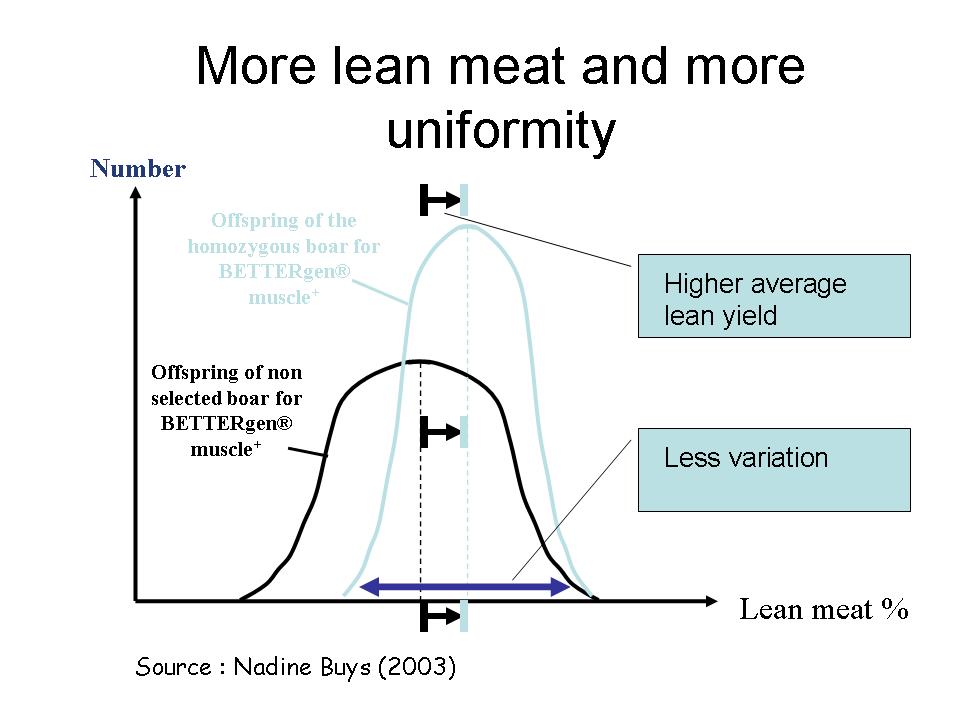
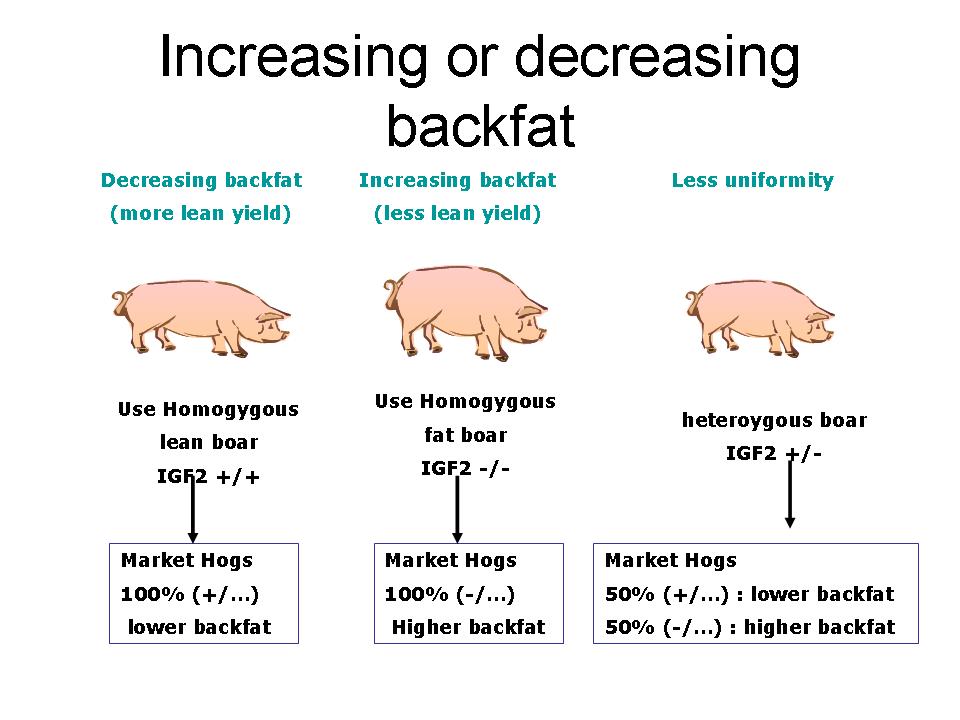
IGF2 gene can increase not only carcass lean yield by about 2% but also uniformity by about 25% according to a study by Gentec, Belgium (Buys. 2003). It can bring the average lean yield of Canadian hogs close to the required level and make the carcasses much more uniform. Boars with IGF2 + / + genotypes can be used to increase lean yield in the progeny while those with IGF2 ─ / ─ genotype can be used to decrease the lean yield.
5. The special imprinting effect
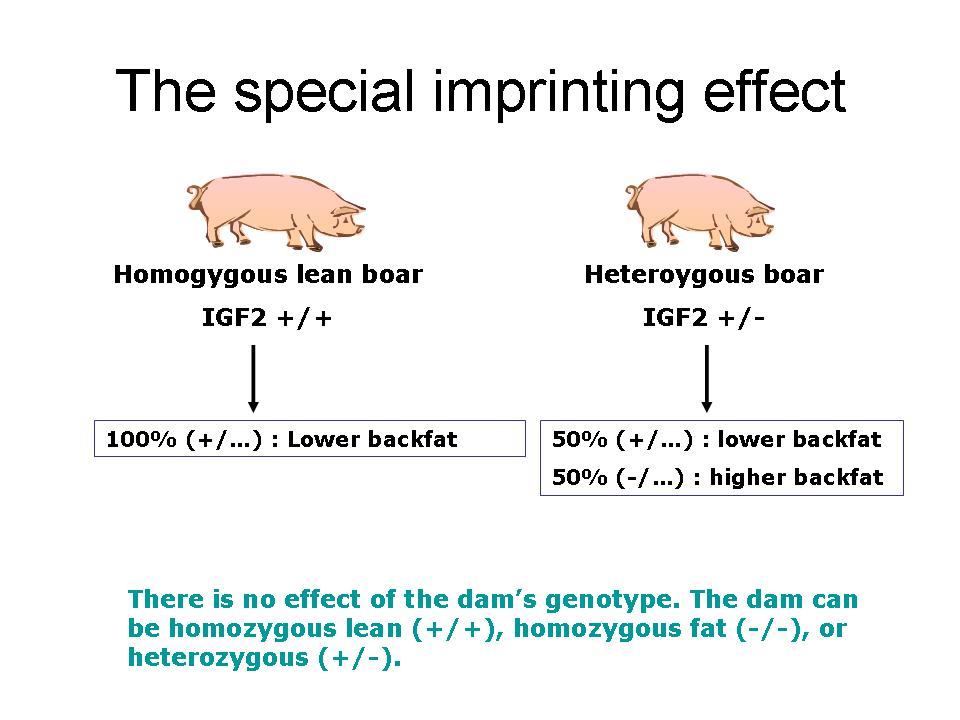
Unlike the commonly known Halothane and RN genes, the IGF2 gene is inherited in a special way. It is an imprinting gene and paternally expressed. This means that the alleles inherited from dams are not expressed. Only the alleles from sires are expressed. Therefore, the IGF2 gene effects in the progeny are determined by the genotype of the sire only, irrespective of the genotype of the dam. Hence, all the progeny from a homozygous + / + boar are expected to be leaner even if the dam has the fat allele IGF2−.�
� 6. Other uses of IGF2 gene
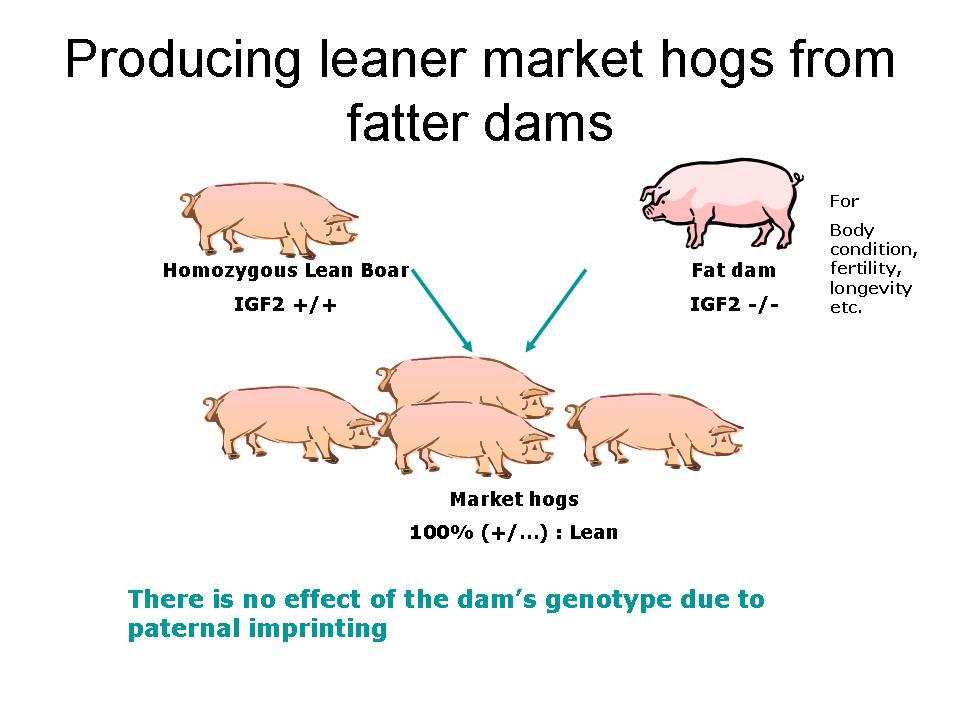
� IGF2 gene can be used to produce pork with the desired level of leanness from fatter sows. If desired, the sows can therefore have a better body condition, and possibly a lower involuntary culling rate. Further research is required to determine if there is an advantage to have the IGF2− gene in commercial sows.
� IGF2 gene can be used to either increase or decrease carcass leanness by using either boars of genotype IGF2 +/+ or IGF2 − / −. Therefore, if the market hogs are too lean and there is an interest to increase the level of backfat, a homozygous fat − /− sire may be used to decrease the level of leanness in the market hogs. The nucleus breeders may wish to screen their herds for the presence of the (−) fat allele and preserve it for such usage.�� � 7. What kinds of pigs need to be tested?
The information provided herewith should give you an idea to make your own judgments based on the cost and benefits for your own use. However, you may consider the following suggestions. � Test boars that are used for breeding. � Test boars used for terminal crossing in AI units � If you wish to select at the time of weaning, which males or females should be put on test, you may send the pig tails for the IGF2 test � If you are interested in preserving the IGF2 (-) allele for higher backfat, you may want to screen the probed pigs, to find those carrying the -/- or +/- genotypes � You may test specific boars or gilts that may give you some marketing advantages You may discuss any other ideas you have with CCSI as well. |